
Dental
All-on-4 Implants
A full arch of fixed teeth supported by four implants.
All-on-4 replaces all teeth of one jaw with a fixed bridge supported by four dental implants. The two back implants are usually angled to make use of available bone, which can reduce the need for bone grafting.
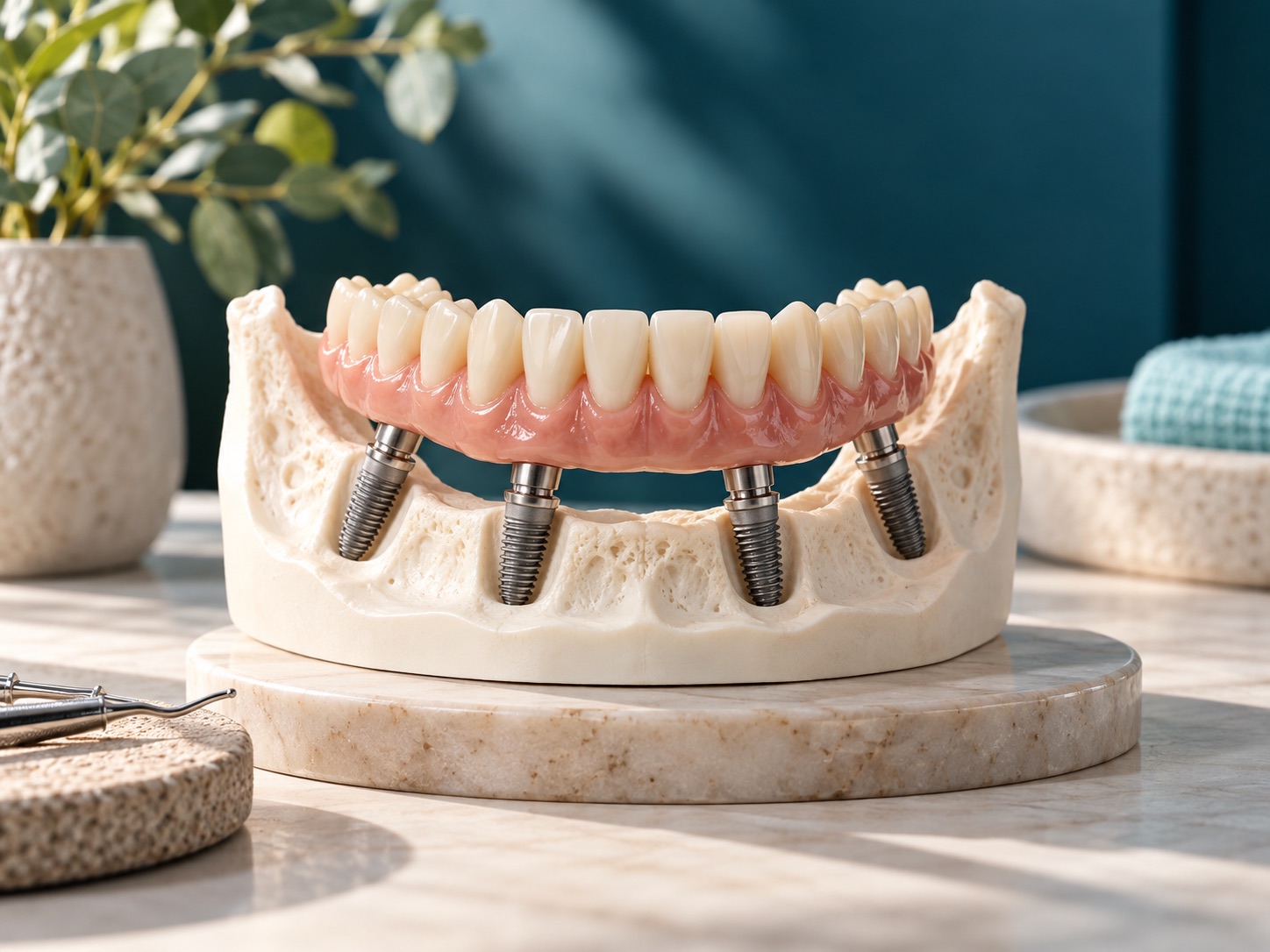
Treatment overview
A temporary fixed bridge is often fitted shortly after surgery, with the final bridge placed after the implants have fused with the bone. Suitability depends on bone volume, gum health and general health.
Common purposes
- Replacing all missing or failing teeth in one jaw
- Moving from a removable denture to fixed teeth
- Restoring chewing function and speech comfort
- Supporting facial contours lost after tooth loss
Free consultation
Free consultation
No obligation. A coordinator replies personally.
Who may be suitable?
- Adults missing most or all teeth in a jaw
- People with adequate bone volume confirmed by 3D imaging
- Non-smokers, or those able to stop as advised
- People whose diabetes or other conditions are well controlled
Suitability is always decided by a specialist after reviewing your health and examining you.
Treatment process
- 01
Before treatment
You share a recent panoramic X-ray or 3D scan and your medical history. A detailed examination and imaging in the clinic confirm bone volume, and the plan — including whether remaining teeth need extraction — is finalised.
- 02
Treatment day
Under local anaesthesia, often with sedation, remaining failing teeth are removed if needed and four implants are placed. A temporary fixed bridge is frequently fitted the same day or within days.
- 03
After treatment
Swelling and mild discomfort are common in the first days. A soft diet is required while the implants integrate with the bone, which takes several months.
- 04
Follow-up
After the healing period, impressions are taken for the final bridge. Annual check-ups and professional cleaning are recommended long term.
Expectations & recovery
Most people return to light daily activities within days; a soft diet continues for weeks.
Implant-bone fusion (osseointegration) takes roughly 3–6 months before the final bridge.
Smoking significantly slows healing and raises the risk of implant failure.
Results and recovery vary from person to person. No outcome can be guaranteed.
Risks & considerations
Potential benefits
- Fixed teeth that do not move while eating or speaking
- Often avoids extensive bone grafting
- A temporary fixed bridge is usually possible early on
- Chewing comfort close to natural teeth for many patients
Risks & considerations
- Infection, bleeding and anaesthesia-related risks
- Implant failure, which is more likely with smoking or uncontrolled diabetes
- The bridge may need maintenance, repair or replacement over the years
- Speech and cleaning routines need a short adaptation period
Questions about this treatment
Independent patient resources
This information is general and does not replace a medical consultation.
Related treatments
- Dental ImplantsReplacing missing teeth with implant roots.
- All-on-6A full arch supported by six implants.
- Hollywood SmileA complete aesthetic smile makeover.
- Zirconium CrownsDurable, natural-looking crowns.
- Dental VeneersThin shells to refine the smile.
- Teeth WhiteningBrightening the natural tooth colour.
Your Next Step Starts With a Conversation.
Speak with a patient coordinator — free and without obligation.
Free Consultation