
Hair Transplant
Beard Transplant
Restoring beard density with your own hair.
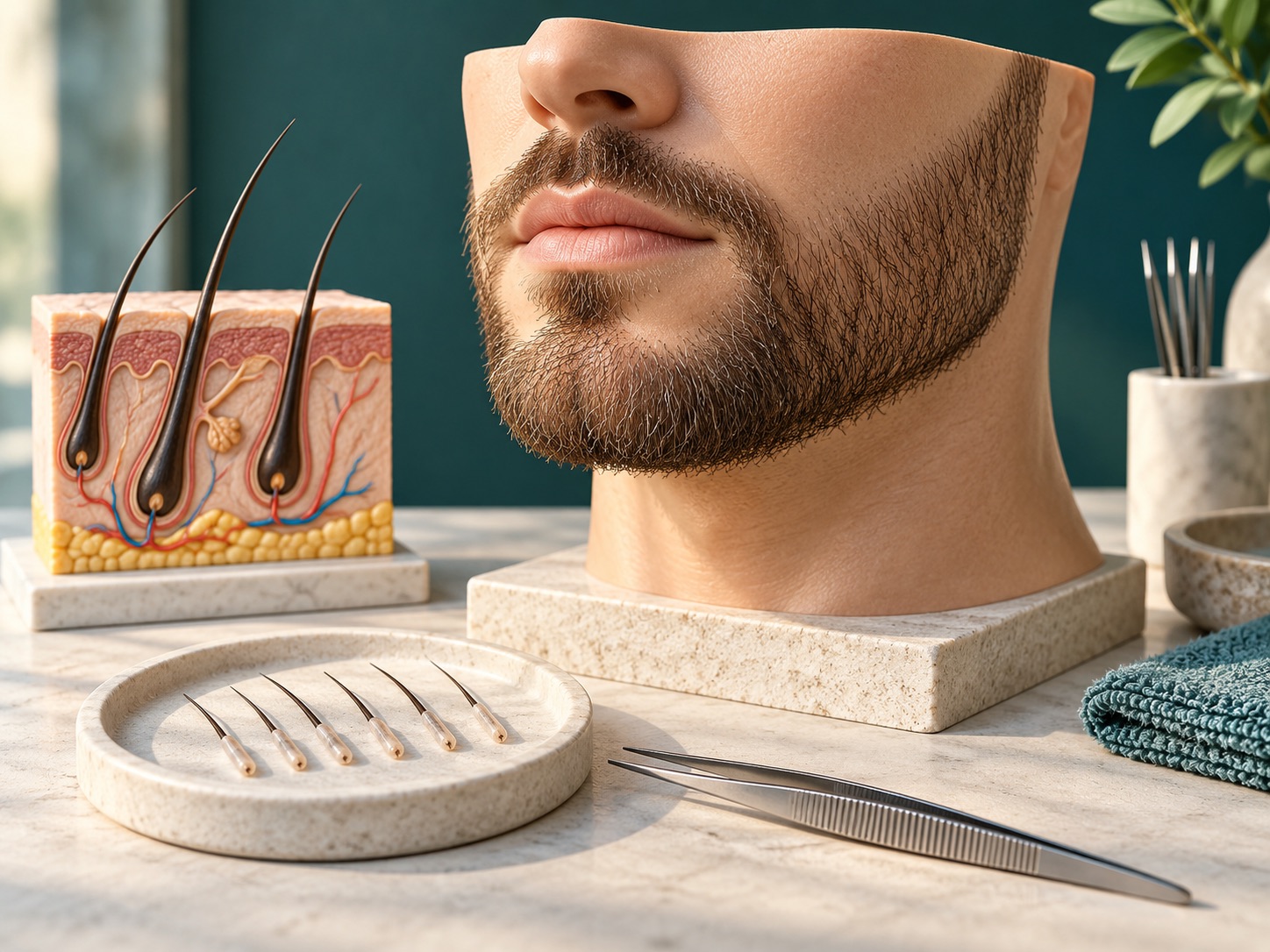
A beard transplant moves hair follicles — usually from the back of the scalp — to patchy or bare areas of the beard and moustache. Follicles are extracted individually with the FUE technique and placed one by one.
Treatment overview
Beard hair has a different growth direction and angle from scalp hair, so placement requires careful planning. The result is permanent, and transplanted hairs continue to grow like beard hair.
Common purposes
- Filling patchy beard areas
- Reconstructing the moustache or sideburns
- Camouflaging scars in the beard area
- Defining the beard line
Free consultation
Free consultation
No obligation. A coordinator replies personally.
Who may be suitable?
- Adults with sparse or patchy beard growth
- People with an adequate donor area
- Those without active skin disease in the area
- People with realistic expectations about density
Suitability is always decided by a specialist after reviewing your health and examining you.
Treatment process
- 01
Before treatment
You share clear photos of your beard and the back of your head. Donor capacity and the planned design are assessed.
- 02
Treatment day
Under local anaesthesia, follicles are extracted and implanted one by one at the planned angles. The procedure usually takes several hours.
- 03
After treatment
Small crusts and redness are common in the first days. Shaving and touching the area are restricted for a period.
- 04
Follow-up
Progress is followed with photos. Transplanted hairs shed in the first weeks and regrow over the following months.
Expectations & recovery
Crusts usually shed within about 7–10 days.
Temporary shedding of transplanted hairs is normal.
New growth typically starts at 3–4 months; the final result is assessed around 12 months.
Results and recovery vary from person to person. No outcome can be guaranteed.
Risks & considerations
Potential benefits
- Permanent result with your own hair
- Natural look when angles are planned well
- Can camouflage scars
- No daily maintenance products needed
Risks & considerations
- Infection, bleeding and swelling
- Uneven growth or lower density than expected
- Tiny dot scars in the donor area
- Ingrown hairs are possible during healing
Questions about this treatment
Independent patient resources
This information is general and does not replace a medical consultation.
Your Next Step Starts With a Conversation.
Speak with a patient coordinator — free and without obligation.
Free Consultation